Introduction and Glossary
Getting people to switch their journeys to more sustainable modes of transport is vital if London is to achieve its target of being a net-zero city by 2030. Transport is one of the largest emitting sectors in London, accounting for around a quarter of greenhouse gas emissions. 1
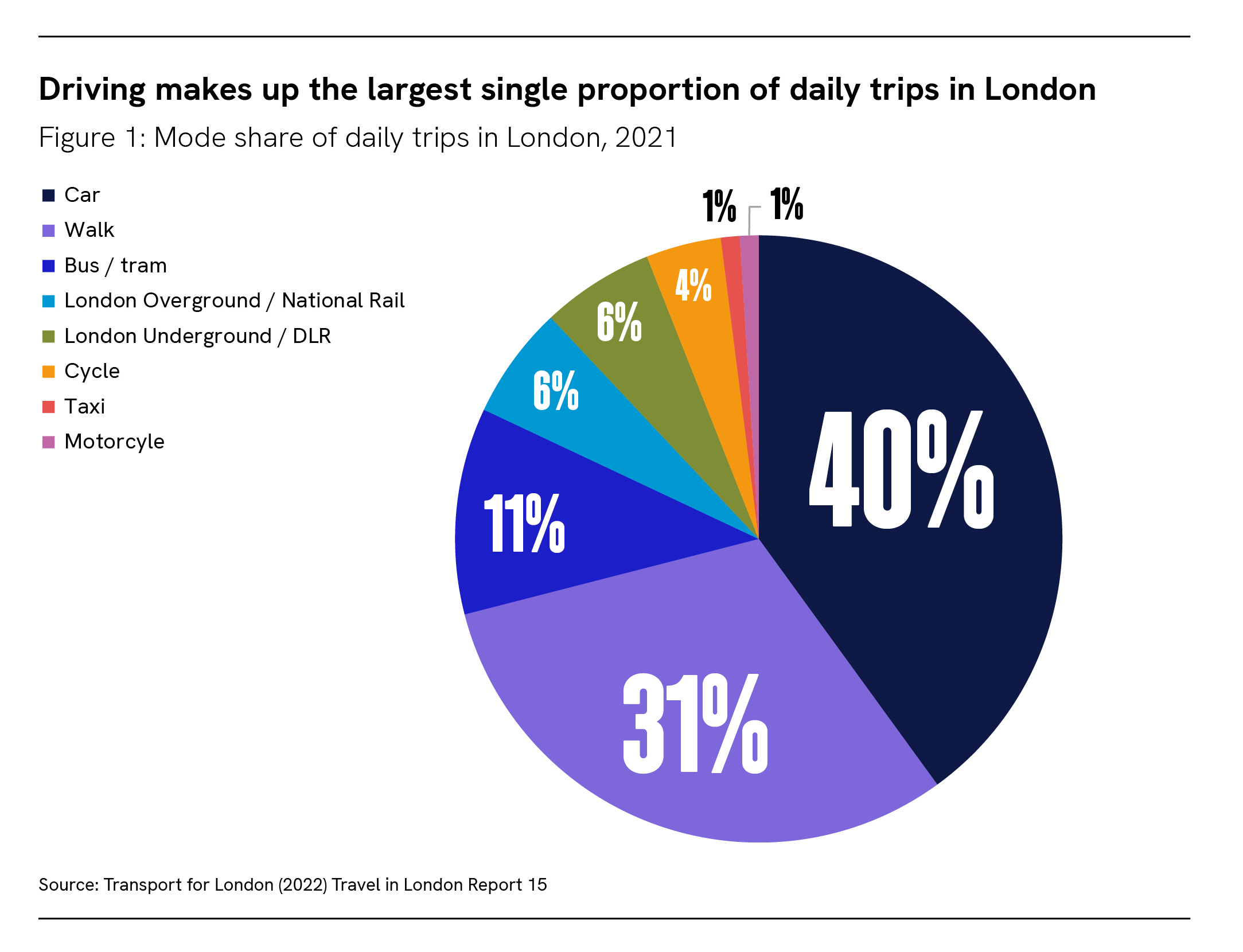
Of this, over 75 per cent is caused by road transport. Road transport is also the leading contributor to air pollution. 2 which is estimated to cause up to 9,400 premature deaths each year. Other negative externalities of driving are congestion and road accidents, making streets less desirable for walking, cycling or spending time in. Yet 40 per cent of daily trips in London in 2021 were made by car (see Figure 1). 3 To encourage the modal shift that London needs, the Mayor has set a target for 80 per cent of journeys to be made by active, efficient and sustainable travel by 2041. But as Figure 1 shows, these modes accounted for just 58 per cent of daily trips in 2021. Analysis by TfL in 2017 found that three-quarters of journeys currently made by car could instead be made on foot, by bicycle or by public transport. 4 And in its latest Travel in London report, TfL predicted that, with the “appropriate incentives”, 21 per cent of residents’ car trips would have a high likelihood of being switched to more sustainable, active and efficient transport modes by 2026. 5
Policymakers can mobilise different instruments to encourage modal shift that can be broadly categorised as: infrastructure investments, regulations, education and nudges, and financial incentives. This report focuses on how financial incentives, including taxes and subsidies, can be used to encourage modal shift.
Financial incentives have proven effective at prompting modal shifts towards cleaner vehicles 6 and active travel. 7 But some financial disincentives, such as road pricing, can be perceived as unfair or ineffective. 8 Positive financial incentives are less negatively perceived by transport users. However, some people have raised concerns about their effectiveness in reducing private car usage.
In this research, we review the incentives in place in London and explore how to change the landscape of financial incentives to help achieve the Mayor’s target for 80 per cent of the trips to be made by active and sustainable modes of transport. In the second part of this report, we illustrate how financial incentives can affect Londoners’ travel costs.
Glossary of key terms:
- Active travel: journeys undertaken by physically active means such as walking or cycling. Journeys made by active travel are typically very low carbon and offer physical and mental health benefits for the individual.
- Financial incentives: financial incentives are used to encourage behaviour change. They could be classified into two broad categories: positive incentives and negative incentives (i.e. disincentives). Positive incentives financially reward people who engage with a certain behaviour whilst negative incentives financially punish people for engaging with the wrong behaviour.
- Modal shift: a change in transport choice. In this report, modal shift specifically refers to a reduction in driving and an increase in sustainable and active travel.
- Multi-modal travel: a travel pattern that involves using two or more modes of transport to undertake one journey – for example, cycling to the station then completing the journey by train).
- Policy package: several policies (or measures) aiming to achieve one or several objectives. Whilst the measures are designed at the same time, they could be introduced in a sequence.
- Shared transport: a model of transport where typically private vehicles are instead shared – for example, rentable bikes like Santander cycles, e-scooters, car rentals and car clubs. Shared transport is considered a more sustainable form of transport because individuals share the resource more efficiently.
- Sustainable travel: an umbrella term for public and shared transport modes. Note that whilst electric, hybrid or hydrogen vehicles are more sustainable than their fossil fuel counterparts, they do still contribute to air pollution (e.g. Particulate Matter) and congestion in urban areas. See our accompanying report on Supporting sustainable travel in Outer London for more detail on why encouraging the take-up of Electric Vehicles (EVs) is not a focus of our transport programme.
- Trip chaining: a travel pattern that involves visiting multiple locations as part of one journey – for example, a parent taking their child to school and then travelling from the school to their workplace.